
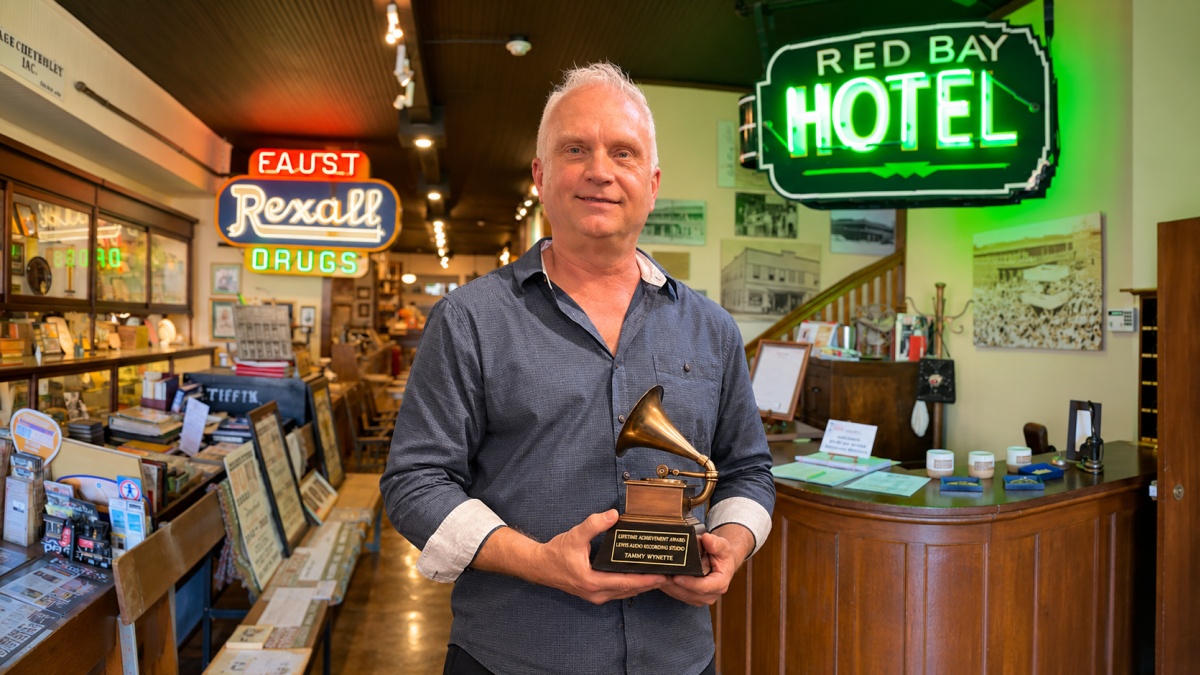
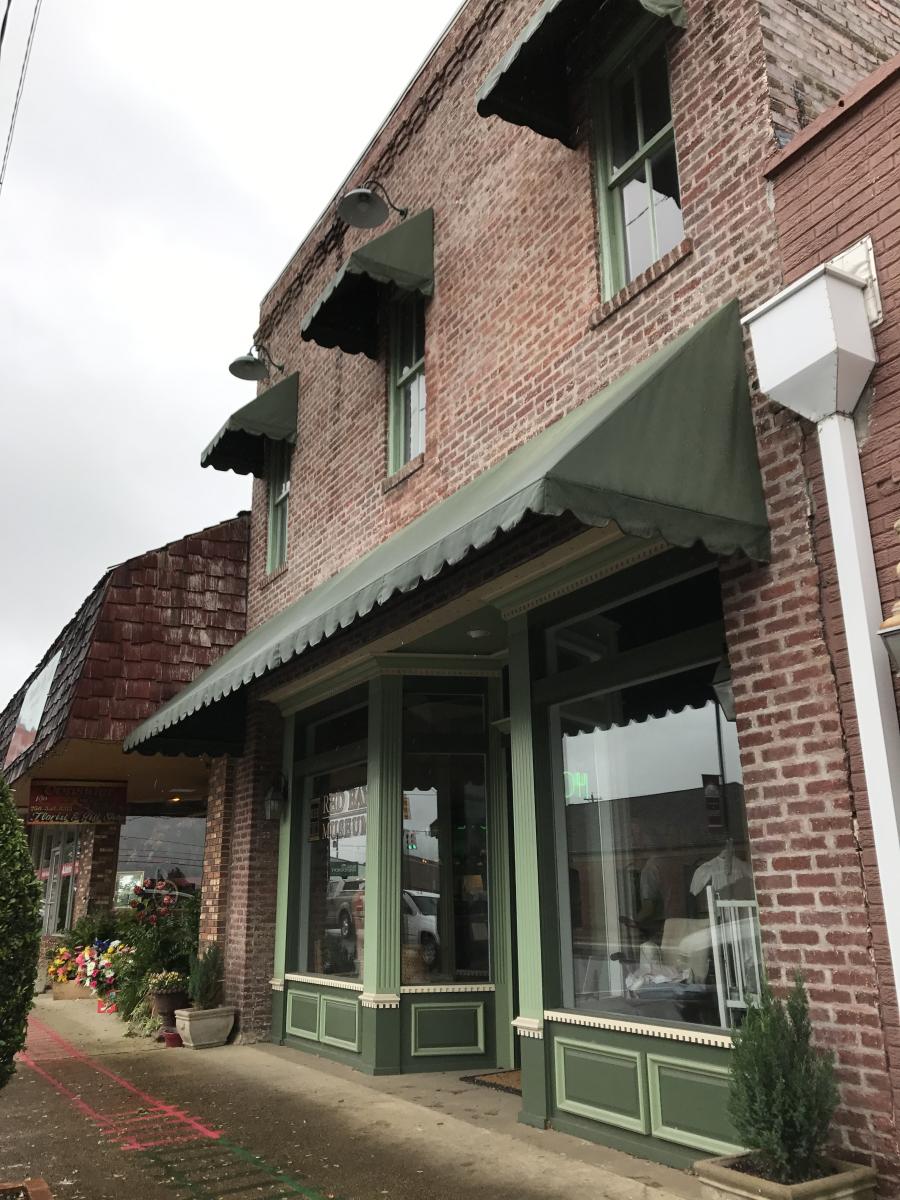
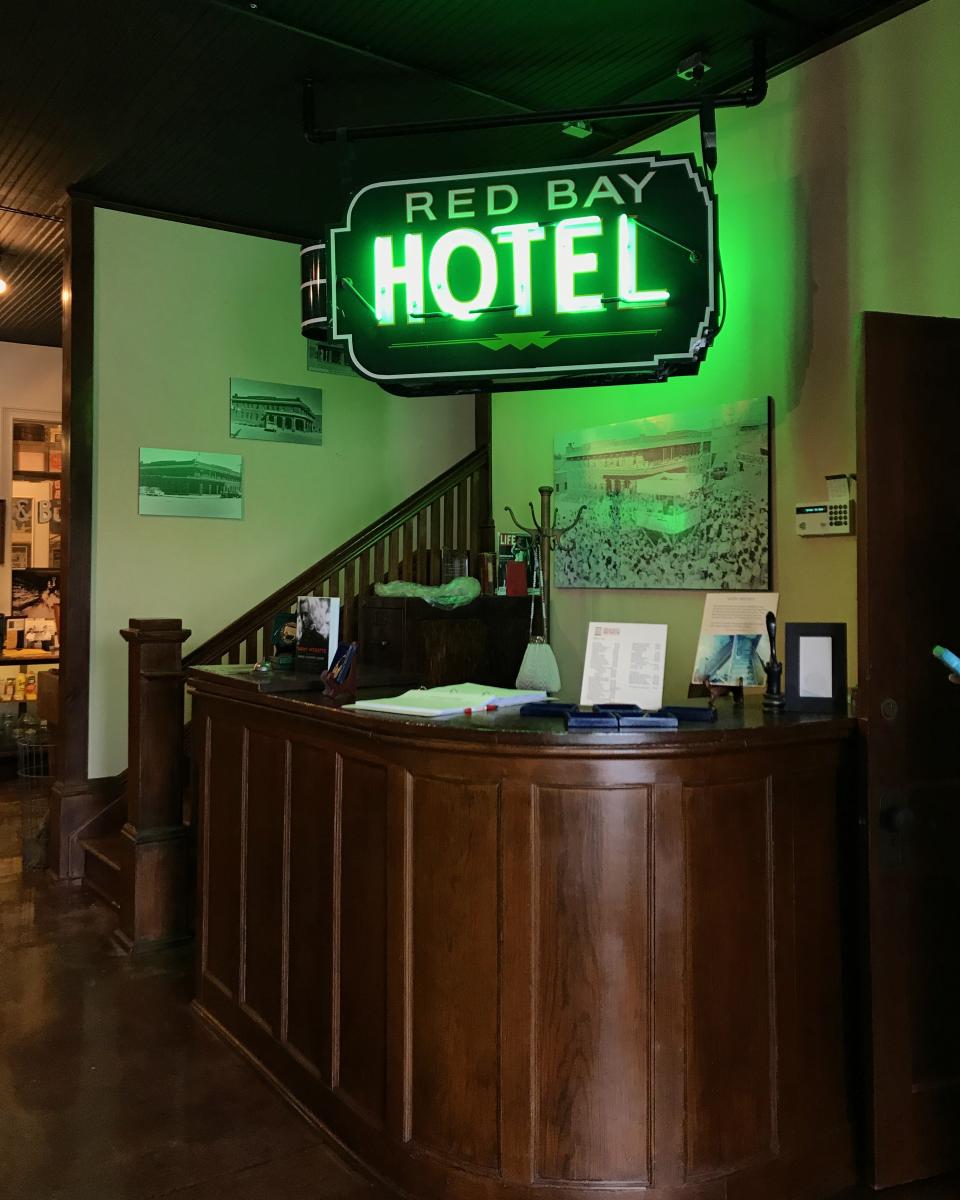
From the sidewalk, the Red Bay Museum looks like any other storefront on a quiet downtown street. Then you step inside, and a green neon sign that says RED BAY HOTEL is glowing over an old front desk, a wooden staircase climbs toward the second floor, and the whole building just keeps going and going.
“When you first walk in, you’ll see what was basically the Red Bay Hotel lobby,” Scotty Kennedy told me.
On Episode 126 of Unexpected Adventures in North Alabama, I sat down with Scotty, the longtime volunteer curator of the Red Bay Museum. Scotty moved to Red Bay when he was six years old, came back after college to open a photography and custom framing studio, and somewhere along the way became the keeper of his whole town’s memory. Red Bay sits about as far west as you can go in North Alabama, right on the Mississippi line. Tammy Wynette called it home, RV owners from all over the country know it by name, and that two-story brick building downtown holds the story of the town. It had been about 10 years since my last visit, and by the end of our conversation I knew I was overdue for another one.
It all started with a history book and a very full attic
The museum grew out of a Red Bay Civitan Club project. The club was putting together a history of the town, and since Scotty had just opened his studio, they asked him to help with the photographs.
“Little did I know what that would lead to,” he said.
The book’s author was former Congressman Carl Elliott, a Vina native, who interviewed Red Bay residents about their lives in town. Along the way, the Civitans realized just how much of Red Bay’s history was still sitting in people’s homes.
“So we told everybody, just hang on to what you got. Maybe one day we’ll have a place to display it.”
Scotty and other Civitan members started showing up at yard sales, estate sales and auctions, collecting anything connected to Red Bay. “I’d have it stored in my attic or under my bed, in the garage,” Scotty said. It stayed there until the club got the building the museum calls home today.

Rebuilding Main Street, one piece at a time
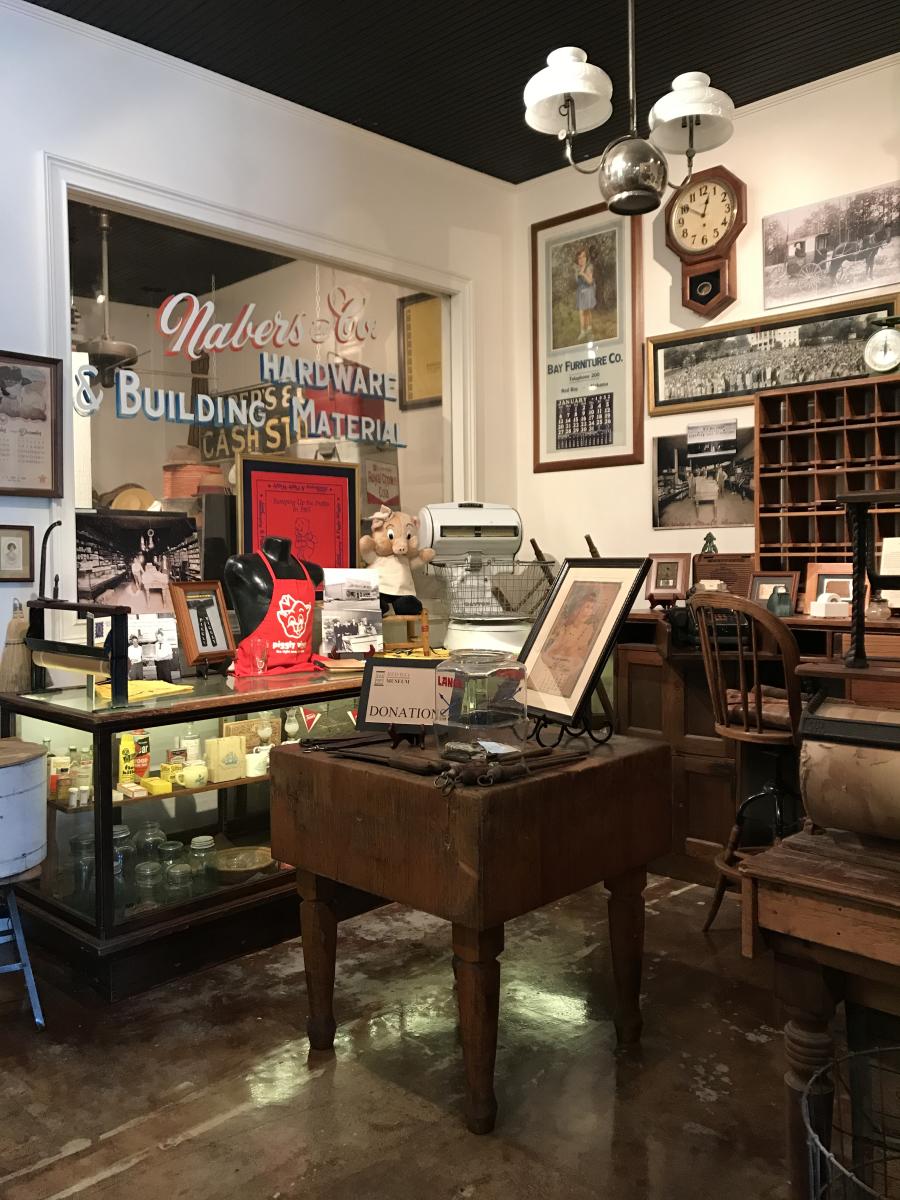
Inside the museum, each exhibit recreates a piece of old Red Bay, and almost every one comes with a story about how Scotty got it.
Take the hotel lobby. The last owner of the hotel’s furnishings kept them in a chicken house and would only sell Scotty one piece at a time. I had to stop the interview and ask why.
“He was a nice man, but he was just odd,” Scotty laughed. “And I think he just enjoyed it, and he enjoyed seeing me beg, and he would not go down on his price one dollar.” Scotty bought the sign first, then went back for the desk, then the furniture, piece by piece. “I was just craving what he had.”
When it looked like the hotel itself would be torn down, Scotty rescued the staircase, windows and doors, including the doors with transoms above them. Those transoms have become a favorite teaching moment. “I explain to the kids there was no air conditioning, so the air had to flow through from room to room somehow.” Upstairs, the museum has recreated the hotel dining room and a guest room, too.
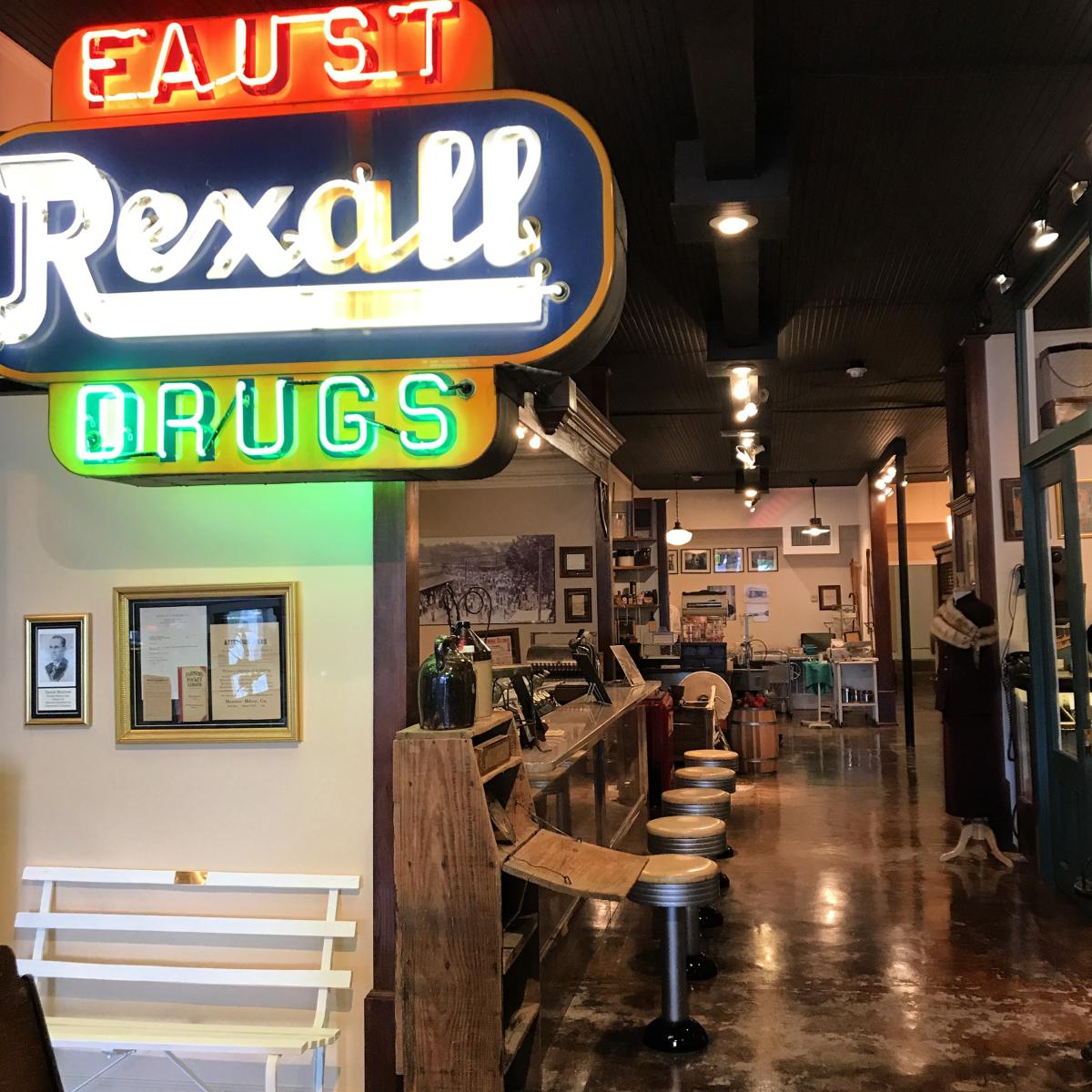
Then there’s the soda fountain. When the town drugstore took it out, the family stored it in a barn on their farm, where the cows wandered right past it. Several people had tried to buy it over the years. The family wouldn’t budge. “But when I told them it’s for the museum, for Red Bay, well, they graciously donated it to the museum.” Today the heavy pink marble fountain sits alongside the store’s ice cream chairs and tables, an old cash register and the Rexall sign Scotty remembers from the 1960s.
Down the way, the Bay Theater exhibit has the theater’s seats and its player piano from the silent movie days. Scotty also learned that movie stars used to come through Red Bay to promote their pictures, including Tex Ritter and a young Bobby Blake, who many of us remember as Baretta.
Not every piece was bought, either. Plenty of families donate, and many more loan their treasures to the museum. As Scotty put it, instead of sitting at home in a closet, “it’s being seen at the museum, and we appreciate the people who do that.”
Why Tammy Wynette called Red Bay home
Then we got to the name everybody asks about. Tammy Wynette was born in Mississippi and went to school in Tremont, but she always called Red Bay her hometown. Scotty has a speech for this one, and he gives it carefully, “to keep everybody’s feelings intact.”
Tammy was born in her grandfather’s house, exactly halfway between Red Bay and Tremont. “It’s 10 miles, I’ve measured it,” Scotty said. But Red Bay was the town she went to for everything. “Red Bay was the closest town she lived to: to the doctor, to the movies, to shop, hanging out with her friends.”
Y’all, I understood that completely. I grew up in Oakville in Lawrence County, and when we said we were going to town, we meant Decatur. For Tammy, going to town meant Red Bay. She even wrote in her autobiography that she got her first kiss at the Red Bay Theater, which is why the theater exhibit leads right into her story.
She never forgot the place, either. Tammy played five benefit concerts for the Red Bay school and came back one year to serve as grand marshal of the Christmas parade.
“So we claim her in Alabama… And they claim her in Mississippi too. So, you know, she would love the fact that both states honor her.”
The night George Jones showed up
One of those benefit concerts, back in 1968, ended up in the history books. Literally. Scotty was there as a 10- or 11-year-old who knew exactly who Tammy was and had no idea who George Jones was.
“I’m at the concert, and this guy comes in, and the crowd just went wild, and he went up on stage and sang with them,” Scotty remembered. “And I really didn’t know what was going on.”
The story shows up in both Tammy’s and George’s autobiographies. A few months later, Tammy left her husband at the time, Don Chapel, and went to be with George. The museum even has a photograph from a little get-together at the American Legion Hut after the show: Tammy, Don, local disc jockeys, Don’s daughter Donna, and George standing right there in the middle of the group.
“So that’s a pretty interesting story that only Red Bay can tell.”
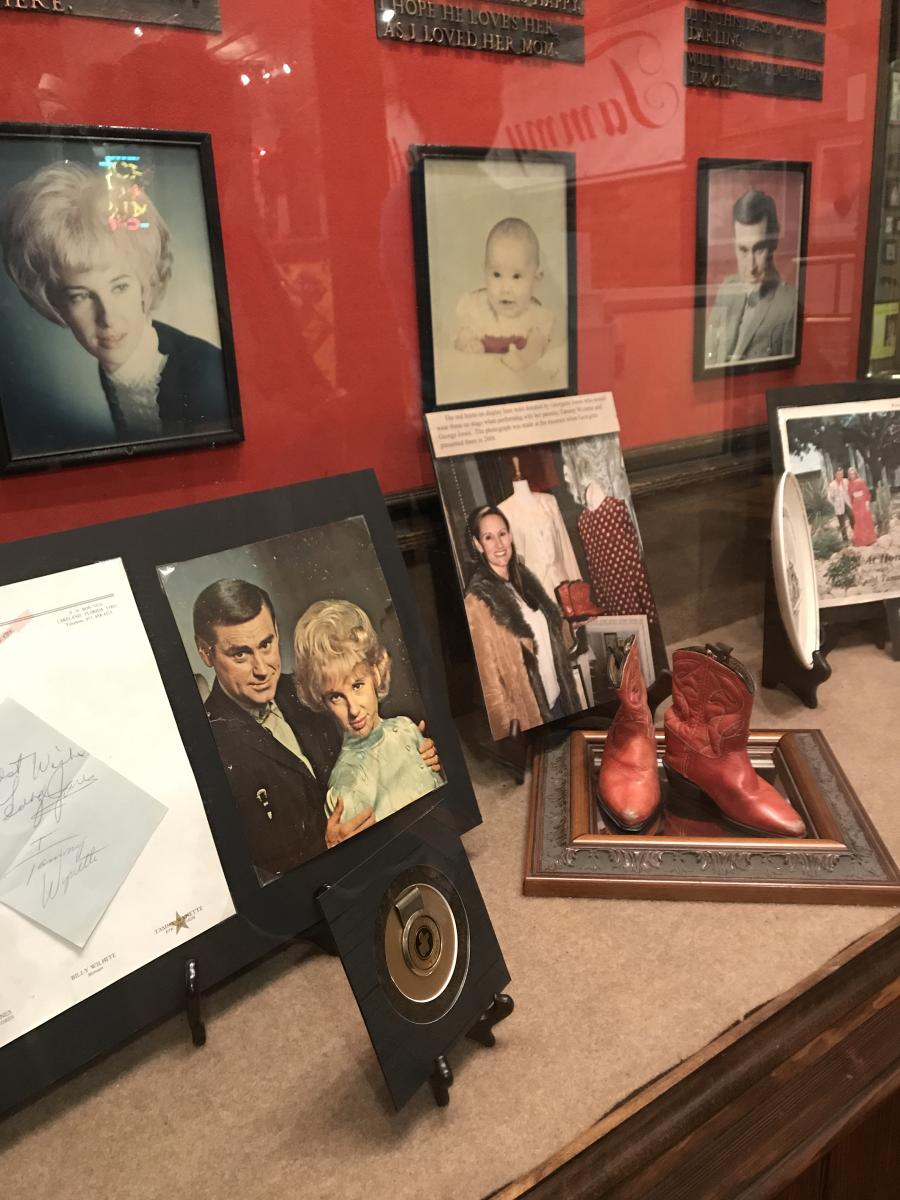
Fans, family and friends: the largest Tammy Wynette exhibit anywhere
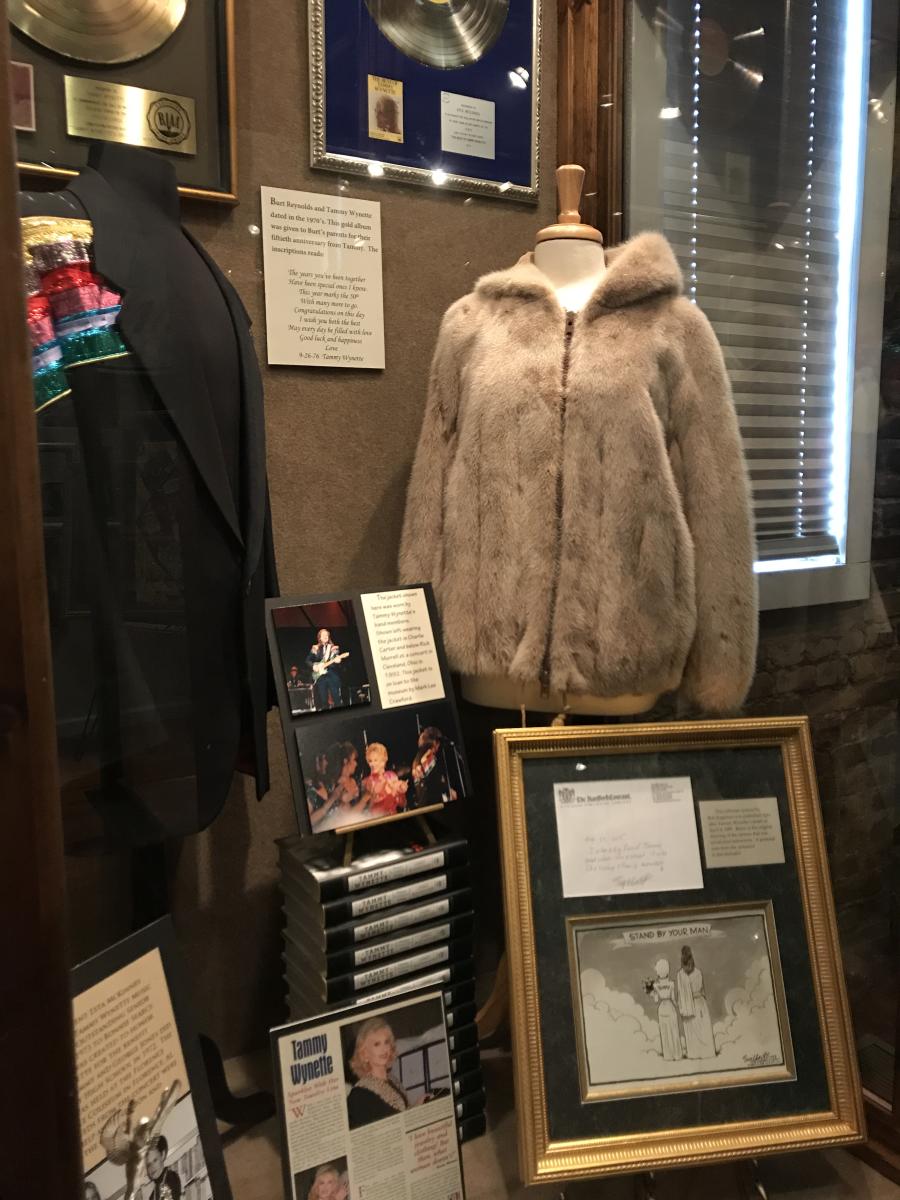
The Tammy Wynette collection fills much of the museum’s second floor. It includes the outfit from her last Grand Ole Opry performance, a piece of the gate from First Lady Acres, her makeup train case and a dollhouse. So how does a small-town museum build something like that?
“Tammy was such a sweet and giving person that she was always giving her clothes away,” Scotty said. He sums up where the collection comes from in three words: fans, family and friends. Relatives around Red Bay still call to say Tammy gave them a dress years ago and it’s hanging in the closet. Strangers reach out on Facebook to say they bought something at an auction. “I’d like to jump through the phone,” Scotty said.
My favorite? When Tammy’s daughter Gwen was in college in Colorado, she called home needing a coat. Tammy mailed her a jacket a talent agency had given her, with “Tammy” right on it. Gwen wore it around campus, and everybody started calling her Tammy. That jacket is at the museum now.
The collection also reaches people in ways Scotty never expected. A visitor from England once asked him to open the museum on a day it was closed, and Scotty met him there. The man’s mother had raised her children on her own, and she played Tammy Wynette songs every morning. “That’s what helped her get through the times when she was alone raising her kids,” Scotty said. Her son later sent Scotty a picture of his mother holding a Tammy poster he’d bought her at one of the museum’s events.
The museum’s photo archive has drawn calls from Ken Burns for his Country Music series, Smithsonian magazine and Rolling Stone. When a Tammy Wynette tribute at the Ryman Auditorium aired on PBS, a photograph donated to the museum made it on screen, with the Red Bay Museum getting the credit. “We’re just trying to keep her name out there and her memory alive, and to honor her.”
And Scotty is still looking. “So if anybody hears this and they have any Tammy items, please get in touch with us.”
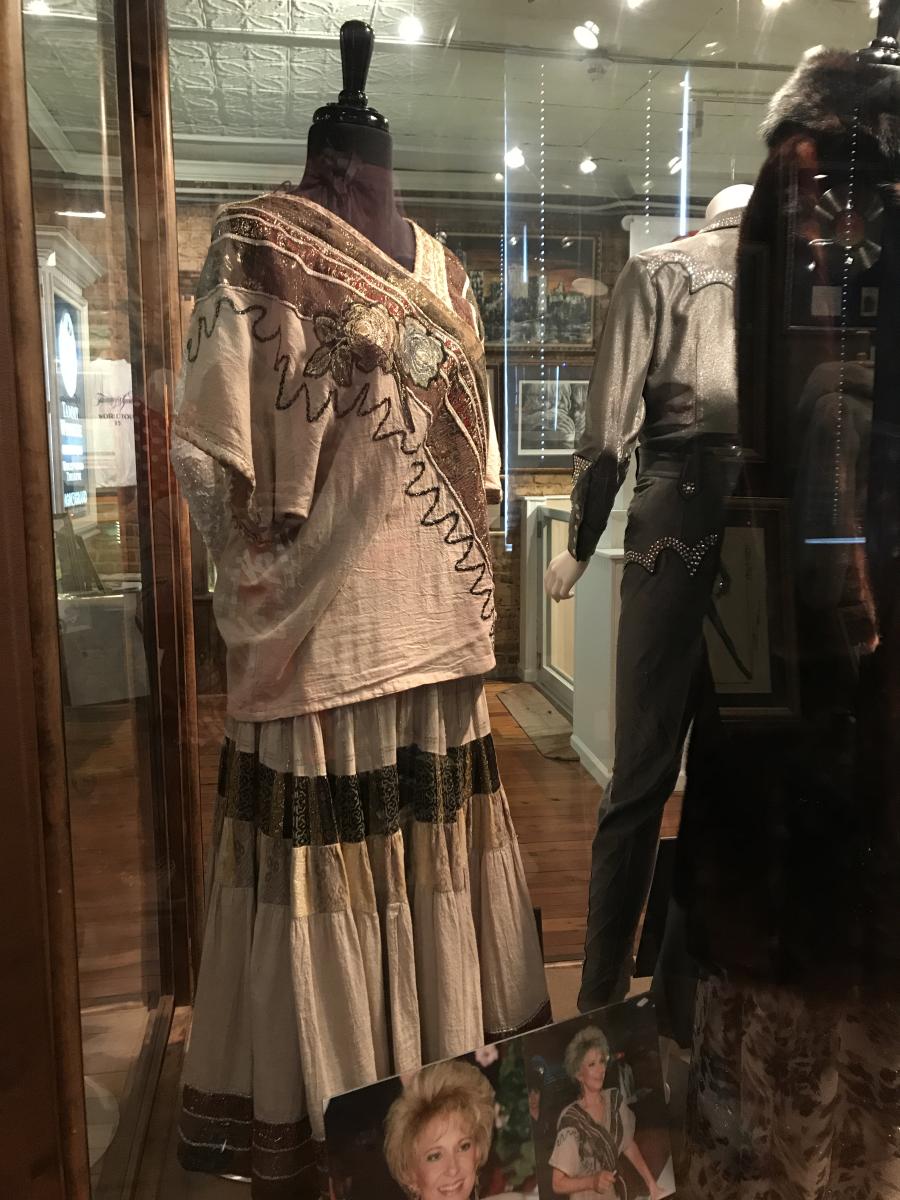
“We had no idea”: the motorhome people
Red Bay is home to Tiffin Motorhomes, and owners drive in from all over to have their RVs serviced. Scotty calls them “the motorhome people,” and while they wait, a lot of them find their way to the museum. He can read the reaction on their faces.
“They say, ‘We had no idea. Had no idea it was this big. We had no idea you had this much stuff in it. We had no idea the Tammy Wynette display was so big.’” And more than one well-traveled couple has told him: “We’ve toured museums all over the country. You have one of, if not the best, small-town museum[s].”
I get it. From the outside it looks like a storefront. Inside, it goes back and back and then up a whole other floor. When the building next door was donated, the museum split it into an annex and a thrift store that helps keep the doors open. Scotty says they’re full all over again.
That kind of teamwork is just how Red Bay does things. “We’re far away from our county seat. We’re kind of stuck over there to the west, you know, on the end. So we’ve always kind of had to fend for ourselves.”
Case in point: the museum’s railroad park across the street. When someone donated a caboose and there was no room for it inside, Scotty and a fellow volunteer raised enough money from local businesses and individuals in a single morning to buy the lot. The town’s old wooden water tower, more than 120 years old, was moved to the park without losing a single board. Then Bob Tiffin found a 1920s steam locomotive and tender that had been sitting in a Pennsylvania building for 66 years, had them restored, and hauled them through five or six states to Red Bay. “You’ll see a lot of cabooses around, and some engines,” Scotty said. “But you won’t see many of the wooden water towers, so I’d say we have the trifecta.”
Plan your trip to Red Bay
Give yourself time. “If you’re with me, just plan to stay there for a while,” Scotty said. The museum is typically open Tuesday and Thursday afternoons, and you can also visit through the thrift store entrance on Fridays. Groups can arrange a guided tour at another time by getting in touch with Scotty. Hours can change, so check the Red Bay Museum on Facebook or redbaymuseum.com before you go.
Make it a day. Tiffin Motorhomes offers plant tours, and Scotty says church and senior groups love pairing a morning factory tour with lunch and an afternoon at the museum.
Branch out. Within about an hour you can reach the Shoals, Cullman or Decatur. Closer in, there’s Dismals Canyon in Phil Campbell and the Bear Creek, Little Bear and Cedar Creek reservoirs. One couple from England told Scotty there was so much to do in the area that they never get it all done.
Follow the music. The Red Bay Museum is a stop on the Music Trail of North Alabama, alongside places like FAME and Muscle Shoals Sound Studio. Grab the free digital passport at northalabama.org, check in at the museum, and keep exploring to earn prizes.
Come back again. The museum is always adding to its exhibits. “Come back on your own, ’cause I can’t show you every little piece here,” Scotty tells his tour groups. “Wander around, look at it at your own pace, and you’ll discover even more.”

What surprised Scotty most
I always ask our guests about something unexpected, and Scotty has a building full of answers. The looks on visitors’ faces still get him. But some of the museum’s best pieces showed up out of nowhere.
While the museum was still coming together, a building in town that had passed through several owners was about to be torn down, and someone stumbled across a stack of old bank cashier windows, the kind with bars. Today they’re part of the Bank of Red Bay display, one of the museum’s most popular, with beautiful oak panels and Tennessee pink marble. “So you just never know [what’s] going to show up out of the blue.”
The railroad and depot display holds a long, Y-shaped wooden stick with a string across it. Depot workers tied paperwork to the string and held it out so someone on a passing train could grab it by hand. “I always wonder what happens if you miss, you know,” Scotty said. And then there’s a handmade kitchen tool made of chicken wire that he assumed was for deep frying. “Come to find out, it’s a whisk.”
Even Scotty’s dreams are about the museum. “I actually dream of finding stuff. When I wake up from this dream, I’m really disappointed.”
Listen to the full conversation
Hear Scotty tell these stories in his own words, including the one about the man with the chicken house, on Episode 126 of Unexpected Adventures in North Alabama. Listen on Apple Podcasts or Spotify.
If you’re always looking for adventure, you’re going to find it, even in a two-story brick building on the Mississippi line. See y’all in Red Bay