
When Pete Conroy started pitching the idea in the early 1990s - a national park unit and a state university sharing one building on the rim of an Alabama canyon - nobody could quite see it. Including him.
“No one could really wrap their minds around it,” he told me. “And neither could I.”
The National Park Service now estimates that the partnership has generated half a billion dollars in economic output.
On Episode 121 of Unexpected Adventures in North Alabama, I sat down with Pete, director emeritus of the Little River Canyon Center at Jacksonville State University, and Angela Bates, an educator with the National Park Service at Little River Canyon National Preserve. Between the two of them, they cover the science, the history, the safety and the day-to-day of one of the most beautiful places in our state and one a lot of people still drive past.

A River That Runs on Top of a Mountain
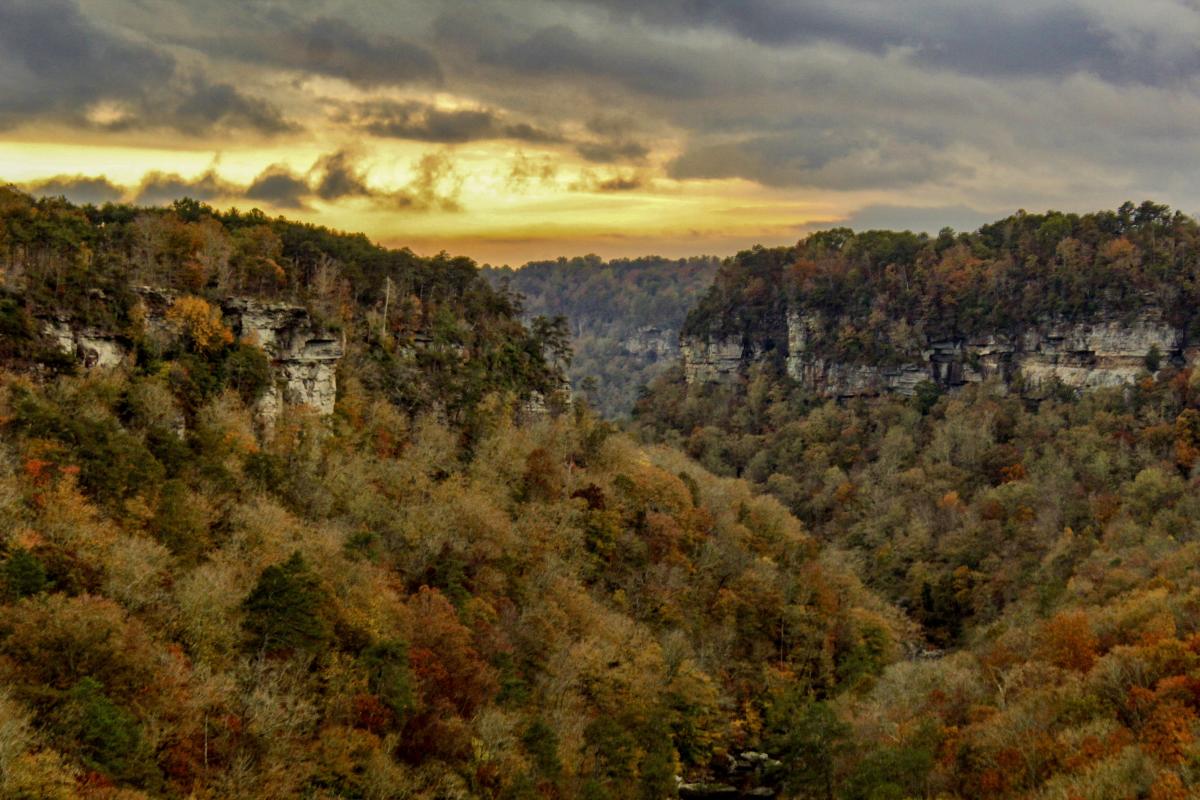
Start with the part that sounds made up. Little River runs along the top of Lookout Mountain, one of very few rivers in the country that does. It travels 23 miles into the canyon it cut, and at points that canyon is 600 feet deep.
“It's very unique, it's very beautiful, and it has a lot of biodiversity in the park,” Angela said. She is not overselling it. This is a river working on top of a mountain, which is not how rivers are supposed to behave.
Pete's shorthand for how the place is run is a Reese's cup: the Park Service and the university, chocolate and peanut butter. The preserve was designated in 1992, and almost immediately he started thinking the programs needed a better home than the rooms he had been borrowing at DeSoto State Park, where he showed up with a screech owl or a kestrel, maybe a couple of snakes and a box turtle. Connections in Huntsville and Congressman Cramer's office eventually turned into $6.8 million and a building.
Three Waterfalls, and the Tallest One in Alabama
There are three, and they are not interchangeable.
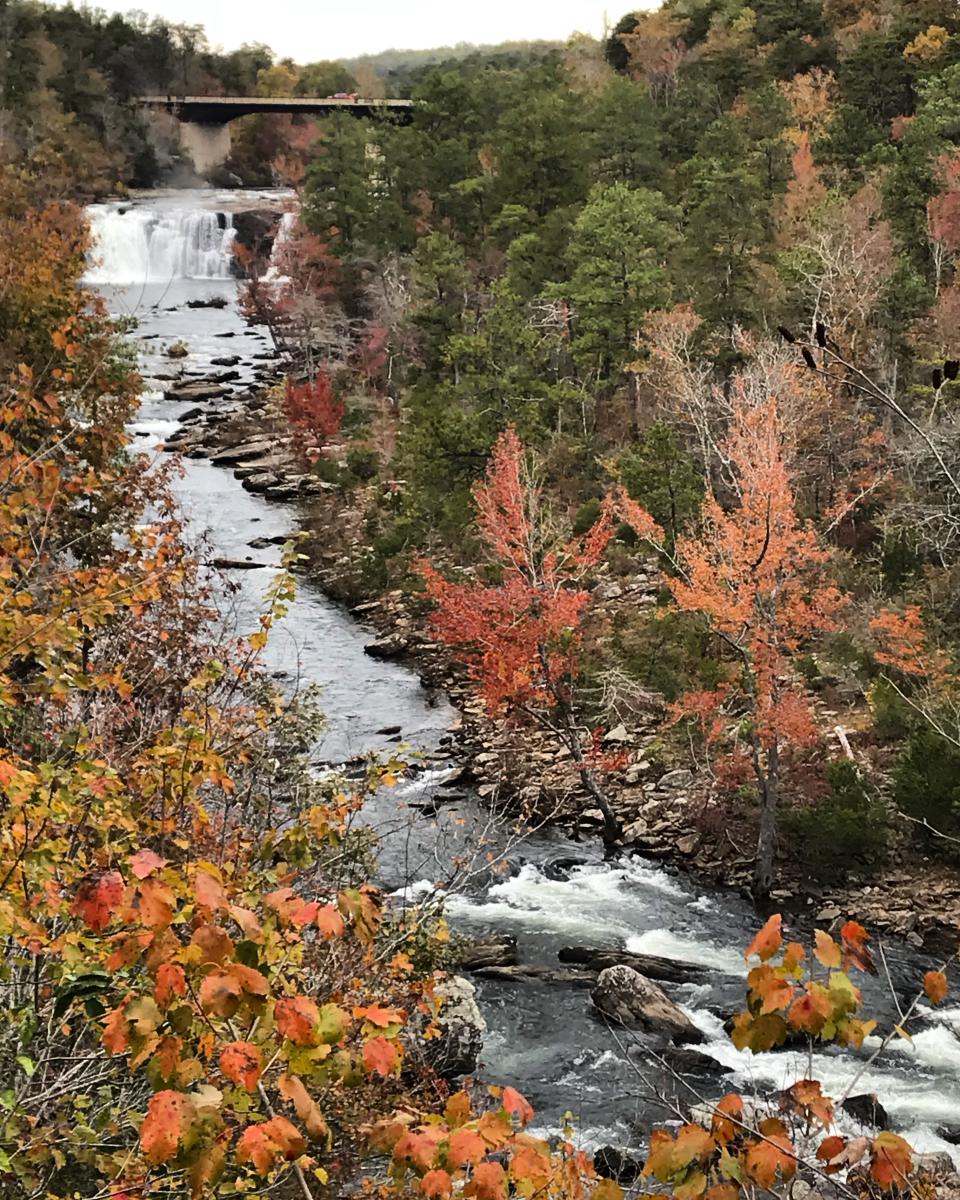
Little River Falls is the main event and the easy one: nearly four stories tall, very wide when the river is up, and visible from the Highway 35 bridge if you do not want to leave the road at all.
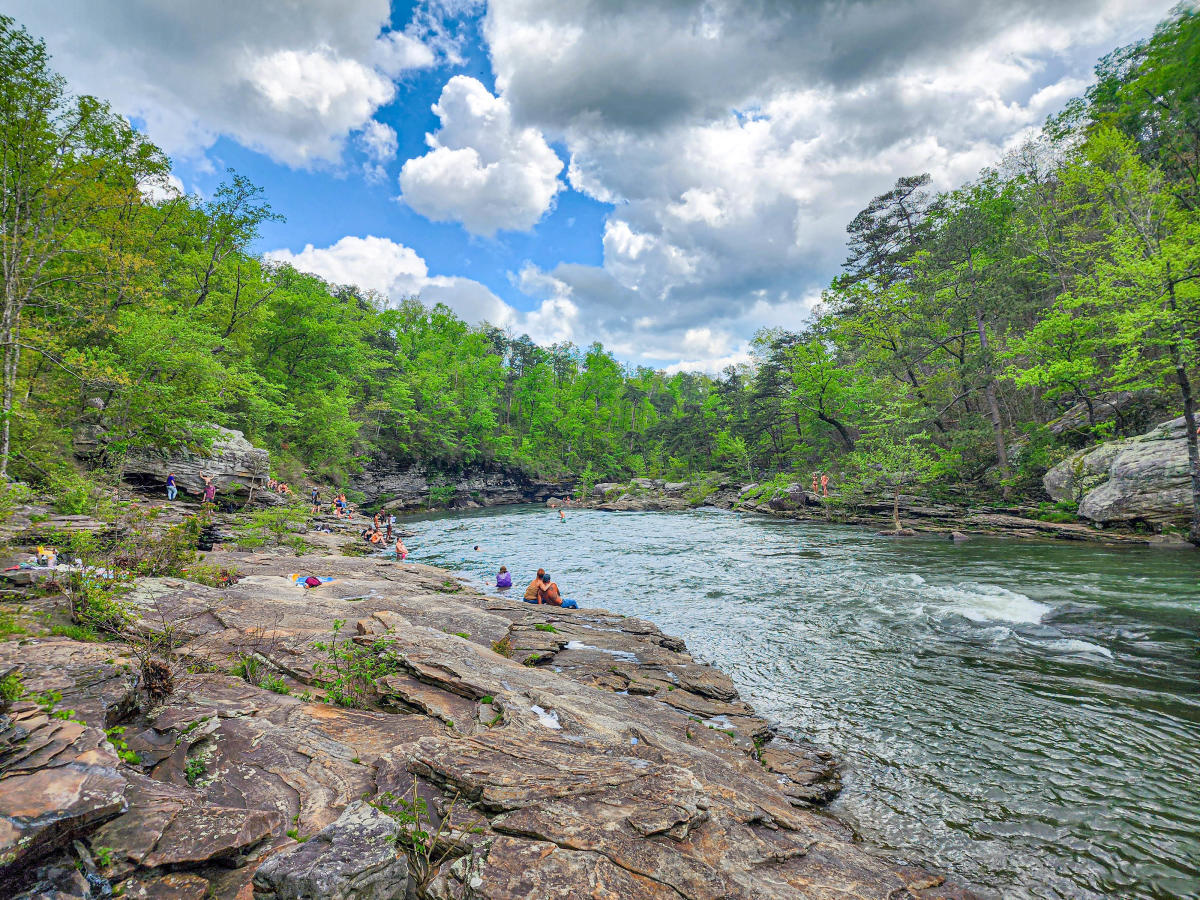
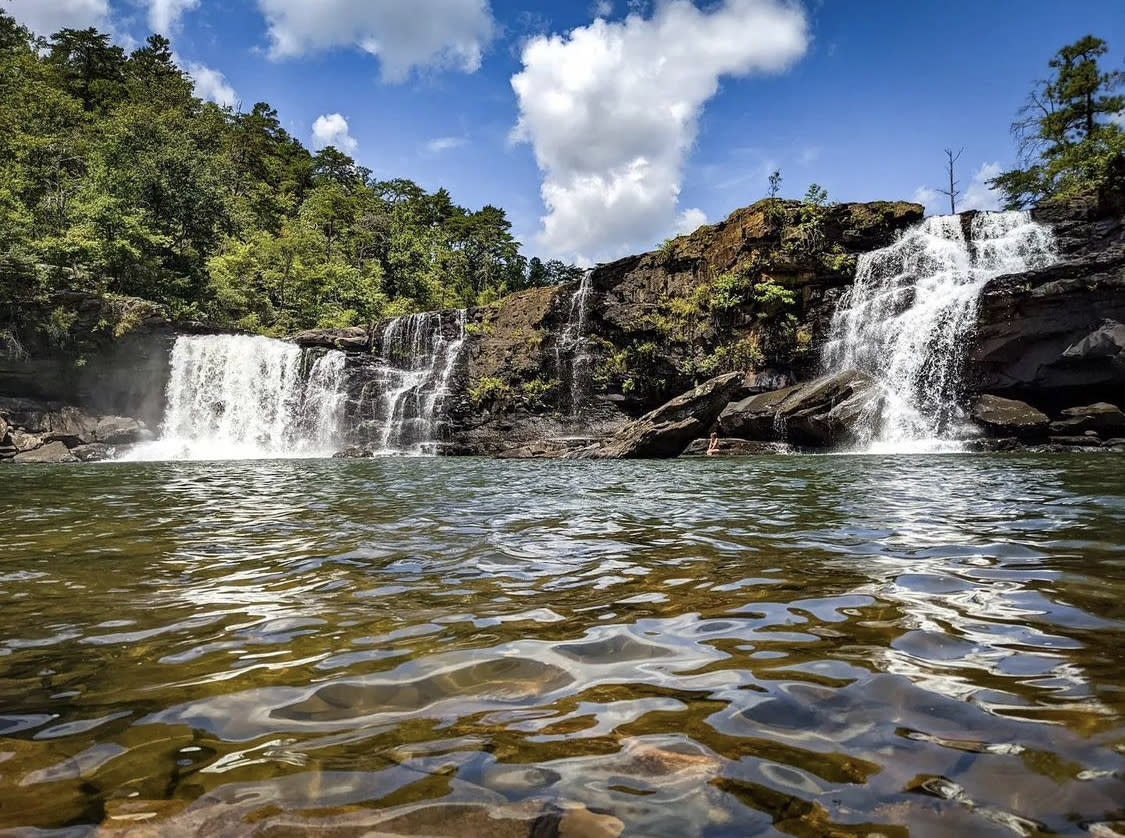
Little Falls is three-quarters of a mile down into the canyon from there. It has gone by several names over the years, and it is the swimming hole — the place people go in July to get in the water.
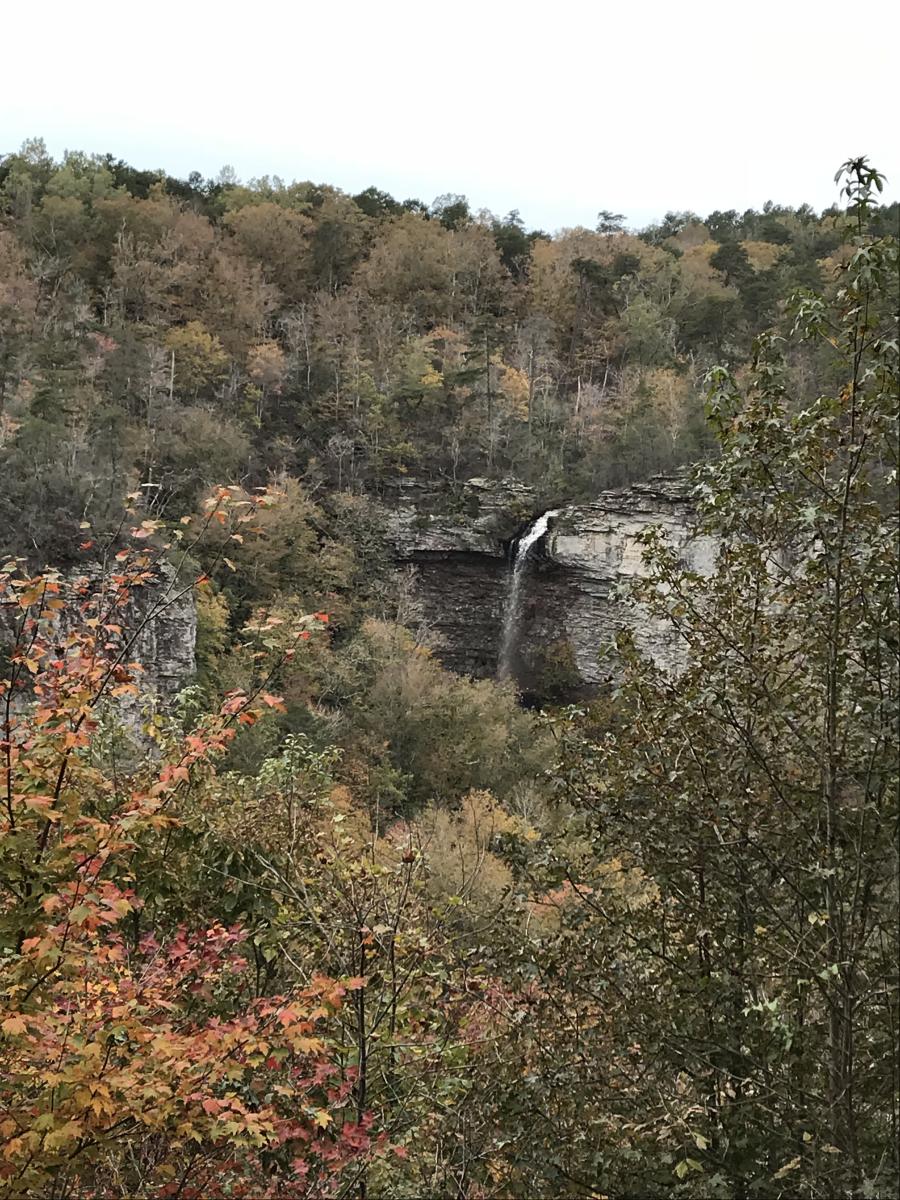
Grace's High Falls is the tallest waterfall in Alabama at 133 feet, and it is seasonal. Angela was blunt about it: she has never seen it run after June. Winter and spring are your window, depending on rain. It comes off the canyon wall across from an overlook on Highway 176, so you watch it from the far side.
Which season is best? Angela refused to pick. Spring gets you the most water and everything in bloom, early November is peak color, and December strips the leaves and hands you the shape of the canyon. Even a dry spell has something: when the water is low, you can see the rock behind the falls — the thing it has been carving this whole time.
Grace's High Falls, ideally in winter or spring when it is actually running. Worth flagging: if this post goes live in fall, the falls likely will not be flowing, so the caption should say when the photo was taken.
Eleven Overlooks You Can See From the Car
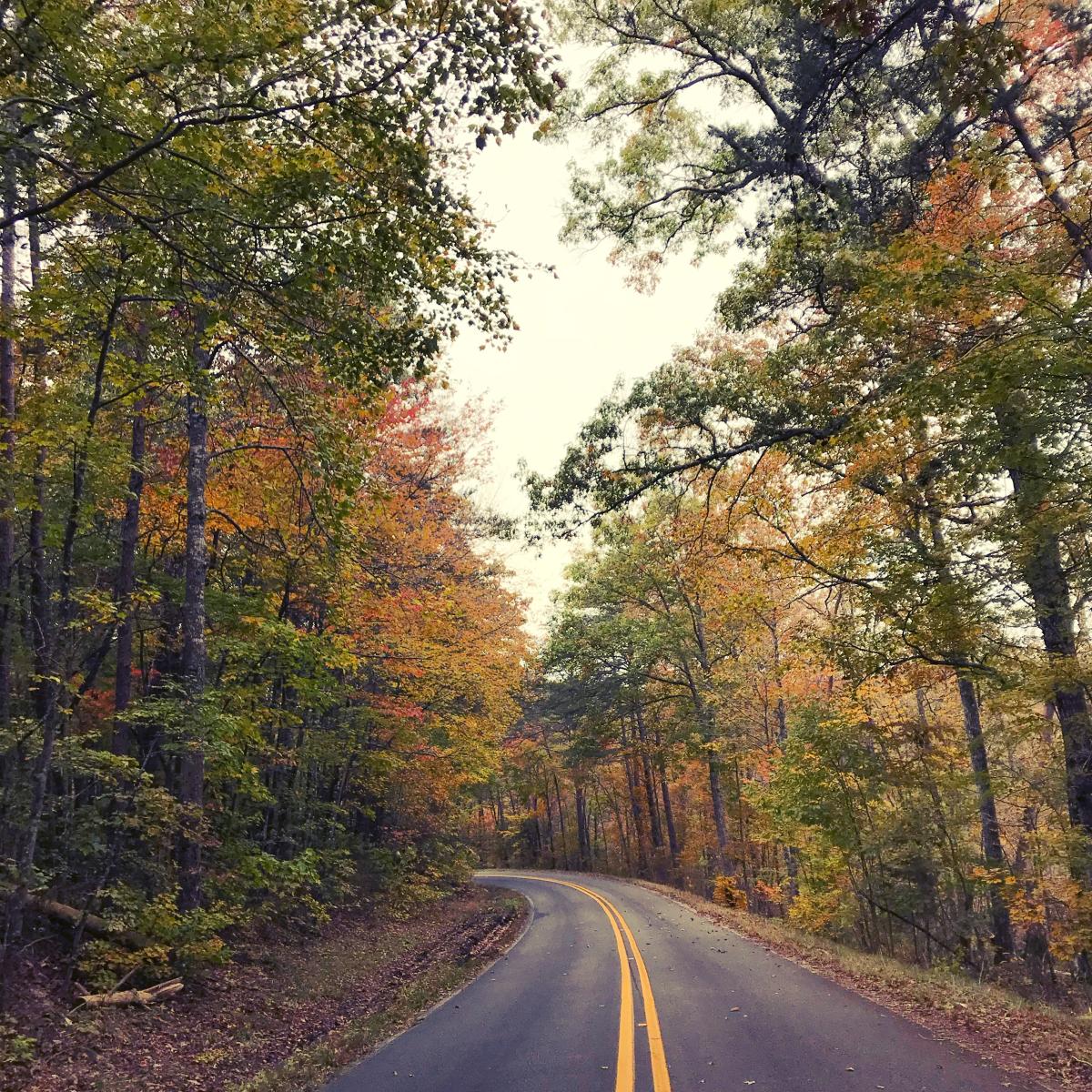
This section is personal for me. My mom used a wheelchair, and one fall she wanted to go see the leaves. We drove Canyon Rim Road and went down the ramp at the falls overlook, and I can tell you firsthand that it works.
Angela confirmed the details. There is a wheelchair ramp down to the Little River Falls overlook. Canyon Rim Road has 11 overlooks, and at several of them you do not have to get out of the car at all — including for the view of Grace's High Falls.
“It's great for people who don't wanna get out of the car for certain reasons, or it's hard for them to get out,” she said.
If you are traveling with someone who cannot hike, this is one of the most rewarding drives in North Alabama, and almost nobody frames it that way.
It's a River, and There Are Cliffs
Pete asked to say one more thing before we finished, and I want to give it the same room he did.
People get hurt here. People have fallen off the waterfall. People have drowned.
Hey, it's a river, and there are cliffs. And so it's slippery, and it can be very dangerous.
He was not trying to scare anybody off. His point was that the outdoors rewards people who know how to be in it — and that the smaller stuff counts too, the ticks and the wasps and the hornets. His advice is the simplest thing in this whole post: if you are not sure how to be comfortable out there, ask somebody at the front desk. That is what they are for.
Mushroom Rock and the Maps That Are Not on the Brochure
Angela's pick for the thing people drive right past is Mushroom Rock, on Canyon Rim Road. It is a giant rock sitting in the middle of the road. As the story goes, the crews building the highway came across it, did not want to destroy it, and built the road around it instead. It is shaped exactly like what it is named for.
Her own favorite spot is Canyon View Overlook, watching turkey vultures ride the thermals in circles over the canyon.
There is also kayaking, rock climbing, horseback riding and hiking — but the practical tip is this: stop at the Canyon Center first. They have backcountry maps for areas that are not on the park brochure, plus directions, plus the current word on hunting and fishing seasons.
The Trail of Tears Crossing at Highway 35
Little River Canyon sits on the official Trail of Tears removal route. The crossing is at Highway 35, right at Little River Falls, and there is a wayside to read on the way to the main falls.
The Park Service tells the story a few ways. There is a separate Junior Ranger book on the Trail of Tears, with its own badge, so kids can learn that history on its own terms. And there are ranger programs on the removal in the wintertime.
The human history here runs much deeper than that. Angela traced it back to roughly 10,000 BC - people using the river and the canyon to hunt and gather - through the Cherokee, the Muscogee Creek and others. Pair a visit with the Oakville Indian Mounds, the Florence Indian Mound, Tom's Wall and the Singing River and you have a genuinely rich few days. (Photo below by North Alabama Ambassador David Parham)

No Junk in the Gift Shop
The Canyon Center is not just a place to pick up a map. Because JSU is a partner, faculty come with it. Dr. Harry Holstein, one of the best-known archaeologists in the state, runs programs where everybody piles into a van and goes out to see the sites, and there are botanists, ornithologists and herpetologists in the rotation too. It is not only science, either: the center books concerts, puppet shows and artists.
Then there is the gift shop, which Pete is quietly proud of.
“We have a commitment to not selling any sort of junk in there,” he said. “Everything in there is of importance. It has a backstory.” Local artists, local craftspeople. I bought honey there once. They are now looking at putting in an apiary within the next couple of years, which means the honey may soon come from the canyon itself.
What Pete says he loves most is the lobby. “I just have the best time ever when I walk into that lobby and I see life taking place,” he said; kids learning, couples on dates, a grandmother who wanted to wait in the car and is now deep in a conversation about bird watching. (Photo below by North Alabama Ambassador David Parham)
What Surprised Them Most
I close every episode the same way.
Angela has been in the Park Service 26 years and worked at eight parks. What still surprises her is this one. “I've never worked at another park who partnered with a college like we do,” she said. Her staff works alongside the JSU Field School on programs and BioBlitzes. A few parks do something like it. Not many.
For Pete, it is that the experiment worked at all. The federal government leases its space from the university well below a typical Park Service rate, and the programming is better because two institutions are pushing it. “It's an experiment that's worked out really well,” he said, “and I kinda hope other parks move in that direction.”
He is careful about the money, though. The half a billion is real and it matters: jobs, taxes, better schools. But: “It's not why we did it. But it sure is a great fringe benefit.”
Plan Your Trip to Little River Canyon
Little River Canyon Center or NPS arrowhead logo, matching the Athens Main Street logo placement in Episode 120. Check usage permissions for the NPS arrowhead before publishing.
Start at the Little River Canyon Center on Highway 35 in Fort Payne. Get your maps, ask your questions, and let the kids pick up a Junior Ranger book at the front desk. They fill it out, take the oath, and leave with a badge, a certificate and a paper hat. There are more than 400 badges to chase across the country, and Angela has met kids racing their friends for them.
Then drive Canyon Rim Road. Eleven overlooks, Mushroom Rock, and the view across to Grace's High Falls. Come in spring for the most water, early November for the color, or December to see the canyon with its leaves off. Whenever you come, wear real shoes and stay back from the edge.
Follow Little River Canyon National Preserve on Facebook and Instagram and look for the blue check mark, and for the NPS arrowhead on the website. Sign up for the Canyon Center newsletter. Angela's new educator alone has 18 events on the calendar this month.

Listen to the Full Conversation
There is more in the episode than fit here: Dr. Holstein's van trips out to the archaeological sites, the junior rangers with hundreds of badges who are openly competing with their friends, and Pete's early days running programs at DeSoto State Park with a screech owl and a box turtle, back before there was a building to put any of it in.
Listen to Episode 121 with Pete Conroy and Angela Bates on Apple Podcasts, Spotify, or wherever you listen.